
“The most expensive words in investing are: ‘This time it’s different.” Sir John Templeton
The world’s largest tech companies have committed roughly $660 billion this year alone to expand data centres.
Trillions more are being positioned behind what many believe is the defining technological race of our era.
The markets are anxious about the spending and monetisation. Software, legal and financial stocks sold off due to the fear that automation would create a huge disruption.
Investors are debating whether we are witnessing the birth of a new industrial age or the prelude to another dot-com bust.
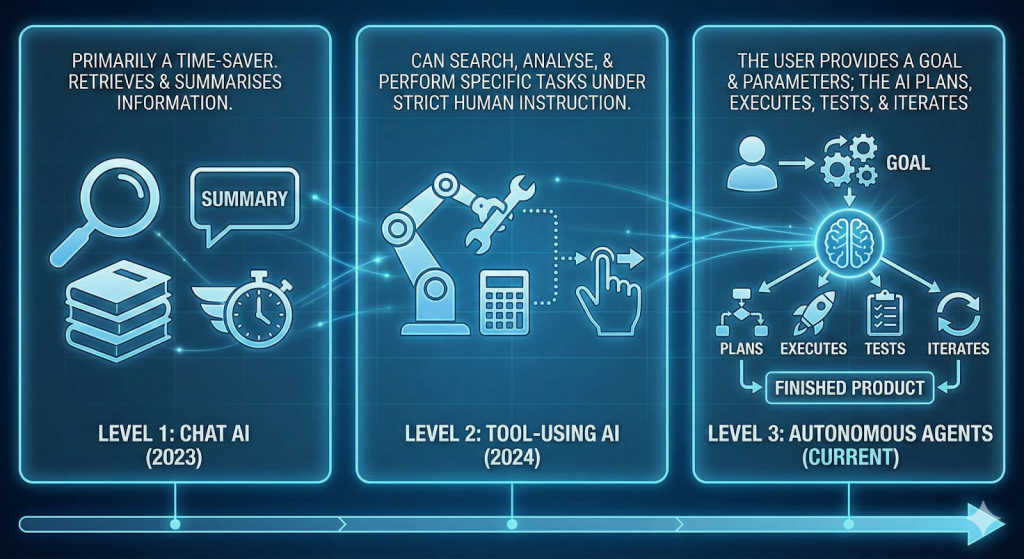
Three years ago, AI felt like a bright intern. It summarised documents, drafted emails, and cleaned up spreadsheets. Helpful, but it was supervised.
However, the technology is making a significant advancement shift from AI as a “research assistant” to AI as an autonomous agent.
Today, AI agents can be given a goal, not instructions, just a goal, and they plan, execute, test, and iterate.
Here’s a simple way to think about it:
Level 1: Chat AI (2023) – Primarily a time-saver. It retrieves and summarises information but does not execute tasks.
Level 2: Tool-Using AI (2024) – Can search, analyse, and perform specific tasks under strict human instruction.
Level 3: Autonomous Agents (Current) – The user provides a goal and parameters; the AI plans, executes, tests, and iterates to deliver a finished product.
There’s a subtle but important distinction in how AI works:
- Training is teaching the system how to recognise patterns.
- Inference is applying the learned reasoning to new tasks
It’s like school versus life.
Humans do something similar. We learn frameworks, then apply them to messy, imperfect realities.
Some sceptics argue that AI is just statistical recombination. Even if that’s true, it’s improving at following instructions to achieve its targeted objective.
If an AI produces the output of a junior for now and is working toward a senior-level capability, investors argue that certain industry valuations need to be reassessed.
Unlike previous industrial shifts, AI targets “thinking” jobs (legal, financial, software and marketplace) and could move faster than society’s ability to retrain workers.
This theoretical future point, often referred to as the singularity or an intelligence explosion, is when artificial intelligence surpasses human intelligence.
It is predicted to trigger rapid, uncontrollable, and irreversible technological growth.
As I mentioned above, this AI technology started in 2023, and the advancement so far has been faster than any other technology historically.
For example, computers took over 40 years to move from laboratory prototypes to homes.
Generative AI reached hundreds of millions of users in about two years.
In addition, new models like GPT-5.3 Codex are already debugging and helping to design the next generation of models.
That’s a compounding loop. It’s like inventing a better engineer who designs a better engineer.
AI has enormous strengths:
- Absorbs and remembers massive amounts of quantitative data.
- Lacks human emotional biases (fear, greed, anchoring).
- Processes “readily available information” more efficiently than any human.
- It works 24/7 without anchoring to yesterday’s mistake.
Humans, though, still dominate in areas that don’t fit neatly into patterns:
- AI struggles with “unprecedented” situations where there is no historical pattern to match.
- Assessing management effectiveness, taste and intuition.
- Humans feel the weight of risk and capital loss, which informs cautious, superior decision-making.
- Understanding of the real world and great at imagining the future.
Unlike the past, such as during the Dotcom Era (1990s), only 7% of fibre-optic capacity was used. There was a massive surplus of capacity.
In the AI era today, 80% of data centre capacity is used. Demand far outpaces supply.
The 1999 investor was funding unused highways. The 2026 investor is expanding roads already full of traffic.
More data has been created in the last 3 years than in all of history.
AI has proved to have massive and immediate demand and utility usage.
In my experience, it significantly boosts my productivity and accelerates processes at a rapid pace.
Although it is not yet perfect and occasionally makes errors, the improvements have been drastic.
I recently discussed the escalating capital expenditure with my colleague Tony at the office, specifically debating whether the significant investment is truly warranted.
Tony contended that Apple’s strategy involves prioritising integration over significant investment in the AI “arms race.”
This emphasis on integration, rather than proprietary development, might prove to be the correct long-term approach for the company.
Of course, they could be right, but Apple recently integrated Google’s Gemini into Siri.
Is this cheaper? Apple thinks so, but Alphabet, the parent company of Google, disagrees, and they do not want to be left behind.
At the moment, it’s impossible to tell who is cautious and who is missing the wave.
History is full of examples:
- The railroads bankrupted many investors but built America.
- The internet crushed thousands of startups but created trillion-dollar platforms.
- Electricity ruined candle makers but illuminated the world.
The Roman philosopher Seneca once said, “Time discovers truth”.
In my view, the giant technology companies are profitable, and they have several parts of their business to keep them going.
My main concern is that many of the AI startups are lottery tickets, and other companies are just calling themselves AI startups.
Alarmingly, some of these entities have secured billions from investors despite lacking a viable business model.
In conclusion, AI has been one of the greatest inventions, as some think it will be bigger than the internet and other innovations, such as electricity.
The rapid influx of capital into this sector is understandable, creating a sense of fear of missing out (FOMO) among investors.
However, given that this represents one of the greatest technological revolutions, it’s crucial to have some exposure.
The key is to participate selectively and focus on profitable and adaptable businesses positioned to benefit significantly from this trend.
This technology holds the potential to solve significant human problems, such as curing various diseases.
Historically, limited processing power was the greatest barrier to progress in this area. However, with current advancements, there is hope that the companies involved will bring about a major transformation in society.

Awet Ghirmay, Head of Investment Research
If you want to learn more about this topic, please find the link here.
More information about our fund can be found here: Hargreaves Lansdown or AJ Bell.
Risk warnings
The value of investments and the income derived from them may fall as well as rise. You may not get back what you invest. This communication is for general information only and is not intended to be individual advice. You are recommended to seek competent professional advice before taking any action. All statements concerning the tax treatment of products and their benefits are based on our understanding of current tax law and HM Revenue and Customs practice. Levels and bases of tax relief are subject to change. This blog is based on my own observations and opinions.


