

Index-linked bonds UK
Since the UK and other countries have experienced a surge in inflation, index-linked bond demand has been increasing. An index-linked bond is a government stock whose return is linked to inflation. It is issued by the UK Debt Management Office (DMO) and is guaranteed by the full faith of the British government.
How to buy index-linked bonds
In theory a UK index-linked bond provides investors with inflation protection because it adjusts both the principal and the coupon payments according to the UK Retail Price Index (RPI). There are several index-linked bonds available in the market, with maturities ranging from 1 year to 50 years. You can buy them from the UK Debt Management Office (DMO) or through a stockbroker. Additionally, they can be purchased through exchange-traded funds (ETF), open-ended investment companies (OEIC) and Undertaking for Collective Investment in Transferable Securities (UCITS).

How do index-linked bonds work?
There is a direct relationship between the price of the bond and the Retail Price Index (RPI), which is a measure of inflation in the UK. If the inflation level rises in a given period, the bond will adjust its nominal coupon payment and final payment to match inflation. Therefore this means the coupon’s final settlement amount will keep up with inflation and protect investors from loss of capital in real terms. The coupon is normally paid on a semi-annual basis and the coupon amount is determined by the benchmark which is the UK Retail Price Index (RPI).
For example, let’s say you invest £2,000 in index-linked gilts with a 2% fixed interest rate. In the next year, if inflation increase by 5%, it will result in the principal value of the bond being adjusted to £2,100 due to the 5% inflation rate increase. In this case, the interest payment will be calculated based on the new principal value, resulting in an increased payment from £40 to £42.
The benefits of investing in UK index-linked bonds
- Index-linked bonds provide reliable hedges against inflation. In the UK, for instance, if your bond wasn’t linked to inflation, you would have lost 13.4% of your purchasing power in the last 12 months. However, if you had invested in index-linked gilts you would have been protected against rising inflation as measured by the RPI Index.
- They have a predictable income stream because bond coupons are fixed, but indexed for inflation, which provides investors with a reliable source of income that keeps up with inflation.
- They provide you with a reliable source of income during retirement and help you to maintain the real value of your investment over time.
- They are considered to be lower risk than other investment products therefore the fixed interest rates are usually lower.
- Investments in bonds are mainly associated with credit risk which is one of the most significant risks. In this case, the UK government is unlikely to default on its promises, whereas companies are vulnerable to default due to several economic factors.
It is important to understand the risks involved, such as changes to interest rates and economic uncertainty, in order to make the right investment decision.
An increase in interest rates has a significant impact on the performance of index-linked bonds, as rising interest rates cause bond prices to fall and investors’ returns will be affected. In contrast, when interest rates fall, bond prices tend to rise, which in turn can result in higher returns for bondholders.
In the past, bond funds were considered less volatile investments and they were a great way to protect your downside risk during market uncertainty. However, during the last few years, index-linked bond funds have not provided the same level of security as they did historically due to high government borrowing and other geopolitical issues.
For example, I have looked at the the three bond funds’ performance below, the Vanguard UK Inflation Linked Gilt Index Fund, the iShares Index-Linked Gilts UCITS ETF, and the Amundi Core UK Government Inflation-Linked Bond UCITS ETF which are are down on average by 17% over the last five years. Since last year, they have also dropped by an average of almost 29%, which has not protected investors against inflation.
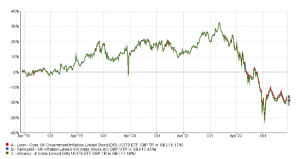
So index-linked bonds can be high risk depending on the economic cycle. When interest rates are falling their value generally roses and when interest rates are rising their value generally falls.
After the first ten months of 2022 government bonds were down 52.% on average and index-linked gilts were down around 70% at the end of October 2022. This was admittedly at the maximum period of economic uncertainty during Liz Truss’s regime as Prime Minister nonetheless it demonstrates that index-linked gilts can sometimes be high risk investments in spite of inflation protection.
It is also important to take into account the market risk associated with UK index-linked bond funds. There is a risk that the value of the fund could fluctuate as a result of changes in the bond market, leading to a decrease or increase in the fund’s value. Index-linked bonds can provide a reliable hedge against inflation and diversification with other asset classes to protect your portfolio from volatility. However, when making a decision, you should also take into consideration your level of risk tolerance and your goals.
Awet Ghirmay, Head of Investment Research
If you’re interested in learning more about this topic, please find the link here.
More information about the fund can be found here: Hargreaves Lansdown or AJ Bell
Risk warnings
*The value of investments and the income derived from them may fall as well as rise. You may not get back what you invest. This communication is for general information only and is not intended to be individual advice. You are recommended to seek competent professional advice before taking any action. All statements concerning the tax treatment of products and their benefits are based on our understanding of current tax law and HM Revenue and Customs practice. Levels and bases of tax relief are subject to change. This blog is based on my own observations and opinions.


